
Landmark recording dossier · 1969
“Amen, Brother”: Gregory Coleman, the Break and the Reframed Kick
A source-led kick-drum listening study of The Winstons’ “Amen, Brother,” Gregory Coleman’s break and the later editing culture that transformed its rhythm.
Recorded break · sampling lineage · original demo
Immediate answer
Why this recording matters to kick-drum history
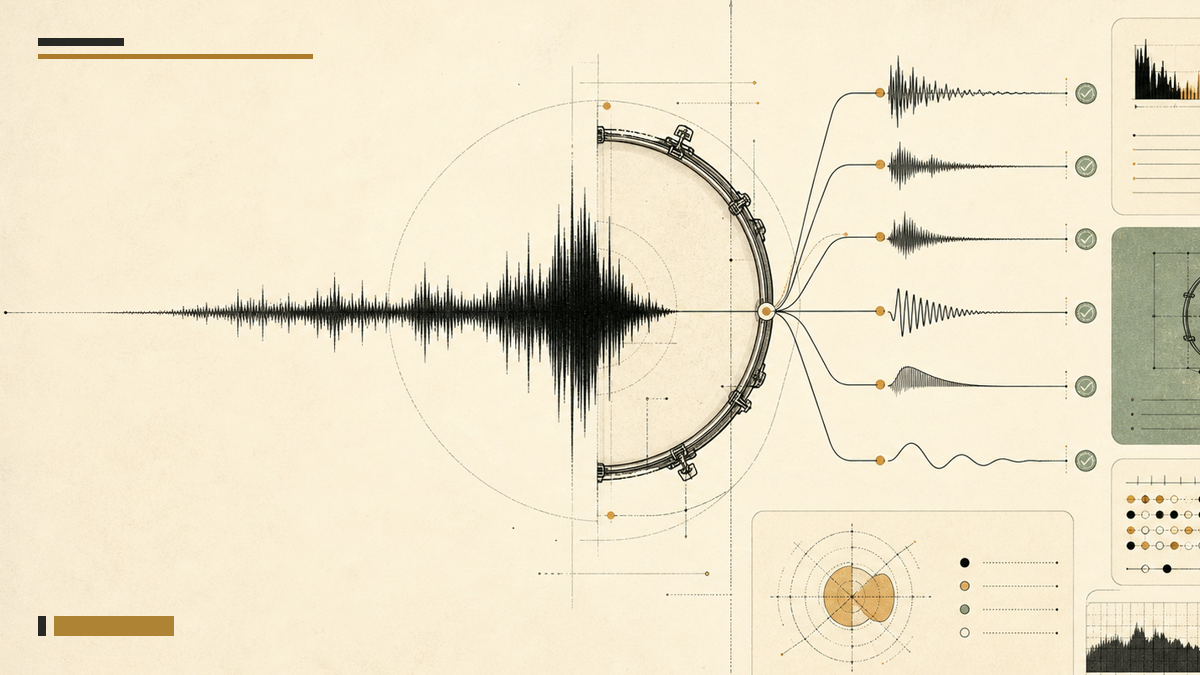
The famous six-second drum break in The Winstons’ 1969 B-side “Amen, Brother” was performed by Gregory Coleman. Its kick became culturally significant not because it was an isolated perfect drum sound, but because DJs, samplers and producers repeatedly cut, pitched, rearranged and recontextualised the entire break.
Historical and musical context
The kick belongs to a complete system
This is a rare case where one recorded phrase became both historical source and endlessly revisable instrument. The kick’s later meanings differ across a hip-hop loop, a pitched jungle edit and a modern drum-and-bass reconstruction. Keeping those stages distinct protects the original performer’s credit while making room for the genuine innovations of the producers and scenes that transformed the break.
Documented record
What the sources establish
- The Library of Congress identifies the 1969 recording, the six-second break and drummer Gregory Coleman in its National Recording Registry material.
- The later afterlife spans hip-hop, jungle, drum and bass and many other forms, but those uses are transformations of a recorded performance rather than a single fixed “Amen kick” preset.
- The original performance and the sampling lineage require separate credit: the drummer created the break; later communities developed new musical languages from it.
Original listening analysis
What to listen for in the kick relationship
Boundary: The observations below describe audible musical relationships. They do not claim access to private stems, exact settings or an undocumented session chain.
- The kick’s identity depends on its relationship with snare, cymbal spill, room sound and the microtiming of the whole phrase.
- Pitching the break changes duration, spectral balance and groove together. The kick cannot be understood as though it were an untouched one-shot.
- Later edits create new kick patterns by slicing the phrase, repeating transitions and changing where the low event lands against the snare.
Original listening model
Hear the kick role, not a copyrighted recording
These short synthesised examples are original Kickopedia demonstrations. They isolate the envelope and low-end relationship described in this dossier; they are not samples, stems or attempted replicas of ““Amen, Brother””.
Choose an example. Keep your playback level moderate.
Translate the lesson
Production experiments to try
- When studying a sampled break, identify the source recording, then identify the transformation.
- Audition edits as phrases. A soloed kick extraction loses bleed and timing cues that make the loop cohere.
- If pitching, compare groove and envelope, not only tone.
- Credit the original performer and the later production tradition rather than collapsing them into one origin claim.
Common mistakes
What this history does not prove
- Treating the Amen break as anonymous raw material.
- Calling every chopped breakbeat an exact copy of the original.
- Removing all bleed and then wondering why the reconstructed loop feels disconnected.
- Assuming a modern isolated sample reveals the original session chain.
Listen for…
A four-part listening checklist
- Kick–snare microtiming
- Cymbal and room continuity around the kick
- How pitch changes groove length
- New accents created by later slicing
Sources and evidence
Inspect the material behind the claims
- 2026 National Recording Registry: “Amen, Brother”Library of Congress
Institutional record for the 1969 B-side, drummer Gregory Coleman and the later cultural life of the six-second break.
- Kickopedia’s Landmark-Kick Evidence MethodKickopedia
The site-wide method for separating credits, equipment claims, recollection and listening analysis.
Related questions
Continue through the lineage
Hip-Hop Breakbeats
Understand the DJ and sampling practices that extended drum breaks.
Open guide →LineageJungle and Drum & Bass
Follow the break into faster editing, sub-bass and rave systems.
Open guide →PatternDrum and Bass Two-Step
Test a modern kick-placement framework without commercial audio.
Open guide →