
Documented recordings · original listening models
Landmark Kick Recordings: Evidence Dossiers and Listening Lineages
Study landmark kick recordings through credits, reliable sources, cultural context, labelled listening analysis and original educational demonstrations.
6 recording dossiers · 12 wider lineages
Immediate answer
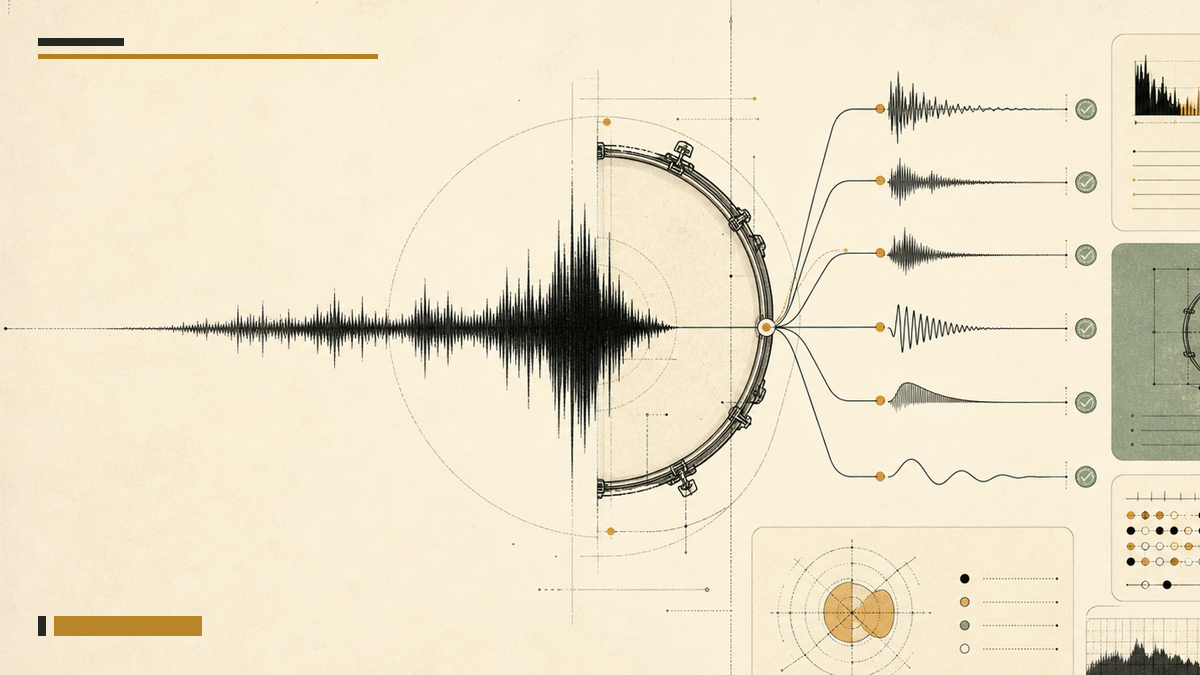
A landmark kick is a documented musical relationship
The useful questions are who performed or programmed it, what the reliable record establishes, how the kick relates to bass and pattern, what playback culture rewarded, and which details remain listening analysis rather than fact.
Recording dossiers
Begin with six specific recorded events
“The Love I Lost”: Earl Young and the Recorded Disco Pulse
A source-led study of Earl Young’s bass-drum pulse on Harold Melvin & the Blue Notes’ “The Love I Lost,” and why a continuous kick became a dance-floor language.
Open guide →1969“Amen, Brother”: Gregory Coleman, the Break and the Reframed Kick
A source-led kick-drum listening study of The Winstons’ “Amen, Brother,” Gregory Coleman’s break and the later editing culture that transformed its rhythm.
Open guide →1982“Planet Rock”: The TR-808 Kick as an Electronic Statement
A sourced study of the production team, TR-808 rhythm language and kick role around Afrika Bambaataa & the Soulsonic Force’s “Planet Rock.”
Open guide →early Chicago house“Your Love”: Drum-Machine Pulse, Intimacy and Early House Circulation
A source-led study of Jamie Principle’s “Your Love,” its relationship with Frankie Knuckles and how a spare drum-machine kick supported an intimate early-house arrangement.
Open guide →1983Cybotron’s “Clear”: Machine Rhythm and Detroit’s Futurist Low End
A source-led study of Cybotron’s “Clear,” Juan Atkins and Rick Davis, focusing on the kick’s place in an early Detroit electronic rhythm system.
Open guide →mid-2000s“Midnight Request Line”: Sparse Kick Placement and Early Dubstep Space
A source-led study of Skream’s “Midnight Request Line,” its early-dubstep turning-point status and the sparse kick choices that leave room for sub-bass.
Open guide →How to use a dossier
Move from evidence to listening to experiment
Read the source boundary
See what is documented, remembered, attributed or incomplete.
Hear the relationship
Listen for placement, envelope, bass ownership and the surrounding rhythm.
Try an original model
Use the synthesised example to isolate one causal idea without copying a recording.
Follow the lineage
Connect the event to scenes, instruments, people and later production practices.
Wider lineages
Continue through genre and playback history
Disco Four-on-the-Floor
Recorded drummers, DJs and the continuous dance-floor pulse.
Open guide →Hip-hopHip-Hop Breakbeats
DJs, breaks, sampling and the kick-bearing moment.
Open guide →ElectroElectro and the TR-808
The kick becomes an unmistakably synthetic voice.
Open guide →HouseHouse Music’s Kick
Community, machines and the continuous floor.
Open guide →DetroitDetroit Techno
Machine rhythm as futurist design.
Open guide →JungleJungle and Drum & Bass
Break editing, sub-bass and accelerated time.
Open guide →UK garageUK Garage and 2-Step
The kick learns to leave gaps.
Open guide →DubstepEarly Dubstep
Sparse kicks, reggae mix weight and sub space.
Open guide →Sound systemReggae and Dub
Drum, bass, space and playback culture.
Open guide →Miami bassMiami Bass
The 808 becomes pitched low-end instrument.
Open guide →AmapianoAmapiano
The kick makes space for the log drum.
Open guide →Regional club formsGqom and Baile Funk
Two different kick-led rhythmic systems.
Open guide →Editorial method
Inspect the evidence yourself
Every dossier includes direct source links and a visible claim boundary. Corrections propagate across linked pages and search answers.