
Landmark recording dossier · 1983
Cybotron’s “Clear”: Machine Rhythm and Detroit’s Futurist Low End
A source-led study of Cybotron’s “Clear,” Juan Atkins and Rick Davis, focusing on the kick’s place in an early Detroit electronic rhythm system.
Institutional history · first-person context · original demo
Immediate answer
Why this recording matters to kick-drum history
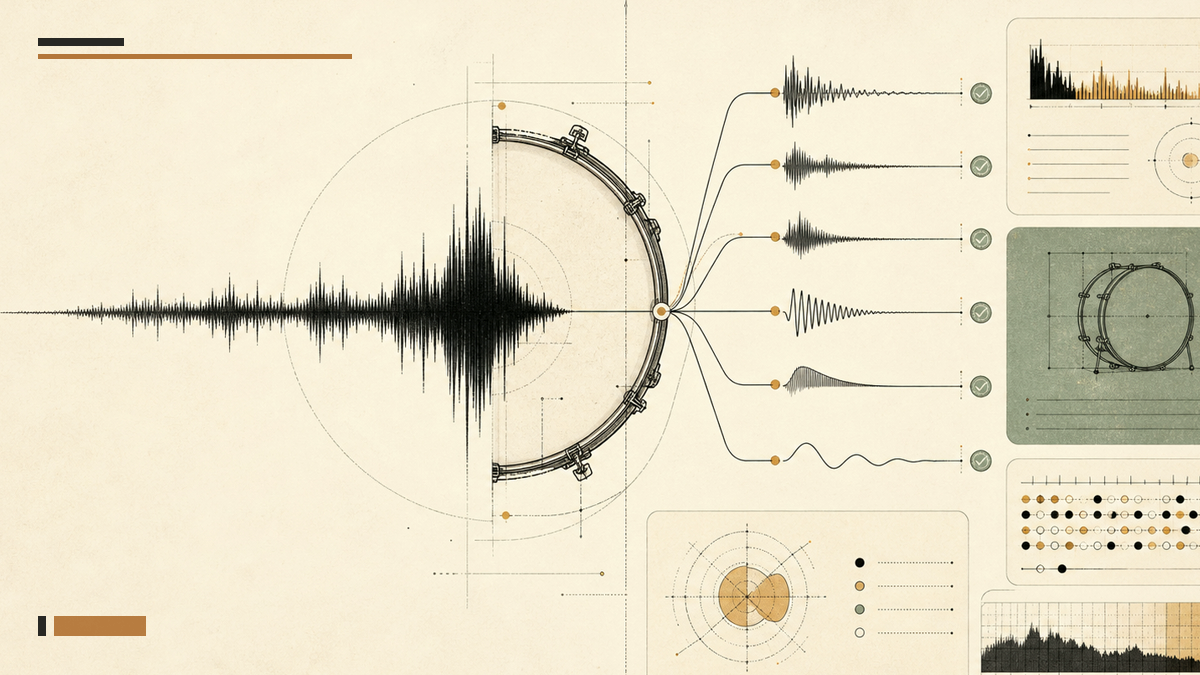
Cybotron’s “Clear” is a key bridge into Detroit techno’s emerging machine language. The kick works as one disciplined event inside a syncopated electronic system; its futurist force comes from arrangement, timbre and repetition together, not from low-frequency size alone.
Historical and musical context
The kick belongs to a complete system
Detroit’s early electronic music drew strength from the relationship between local conditions and an outward-looking technological imagination. On “Clear,” the kick is useful precisely because it does not monopolise the arrangement. A compact anchor gives bass, handclap-like accents and synthetic figures enough separation to articulate the grid. The result demonstrates that futuristic weight can come from organisation as much as from sub extension.
Documented record
What the sources establish
- The Detroit Historical Society connects Juan Atkins and Rick Davis as Cybotron and identifies “Clear” in Atkins’s early career.
- Atkins’s interviews provide first-person context for Detroit’s electronic influences and machine-centred production ideas.
- Kickopedia avoids assigning an exact machine or signal chain unless the cited source supports that specific claim.
Original listening analysis
What to listen for in the kick relationship
Boundary: The observations below describe audible musical relationships. They do not claim access to private stems, exact settings or an undocumented session chain.
- The kick is compact enough to coexist with an active electronic bass framework.
- Its regularity helps syncopated upper percussion and synthesiser figures sound more angular.
- The rhythm communicates precision, but the musical identity also depends on negative space and phrase-level changes.
Original listening model
Hear the kick role, not a copyrighted recording
These short synthesised examples are original Kickopedia demonstrations. They isolate the envelope and low-end relationship described in this dossier; they are not samples, stems or attempted replicas of “Cybotron’s “Clear””.
Choose an example. Keep your playback level moderate.
Translate the lesson
Production experiments to try
- Shorten the kick before boosting its attack when an electronic bass line already carries weight.
- Use a consistent anchor to make surrounding syncopation easier to perceive.
- Build the drum system as one arrangement rather than perfecting each hit in isolation.
- Connect Detroit innovation to people, place and ideas, not merely to a machine list.
Common mistakes
What this history does not prove
- Assuming techno impact requires a long or distorted kick.
- Naming exact hardware from sonic resemblance.
- Ignoring Rick Davis when reducing Cybotron to a single-person story.
- Copying timbre without studying the spaces between events.
Listen for…
A four-part listening checklist
- Compact machine-weight
- Kick–bass division of labour
- Syncopation made legible by a stable anchor
- Phrase changes inside apparent repetition
Sources and evidence
Inspect the material behind the claims
- Juan AtkinsDetroit Historical Society
Institutional biography connecting Juan Atkins, Rick Davis, Cybotron and “Clear”.
- Juan Atkins on the Detroit Techno SoundMusicRadar
First-person discussion of Detroit techno’s machines, ideas and production culture.
- Kickopedia’s Landmark-Kick Evidence MethodKickopedia
The site-wide method for separating credits, equipment claims, recollection and listening analysis.
Related questions