
Landmark recording dossier · 1982
“Planet Rock”: The TR-808 Kick as an Electronic Statement
A sourced study of the production team, TR-808 rhythm language and kick role around Afrika Bambaataa & the Soulsonic Force’s “Planet Rock.”
Documented machine context · team credits · original demo
Immediate answer
Why this recording matters to kick-drum history
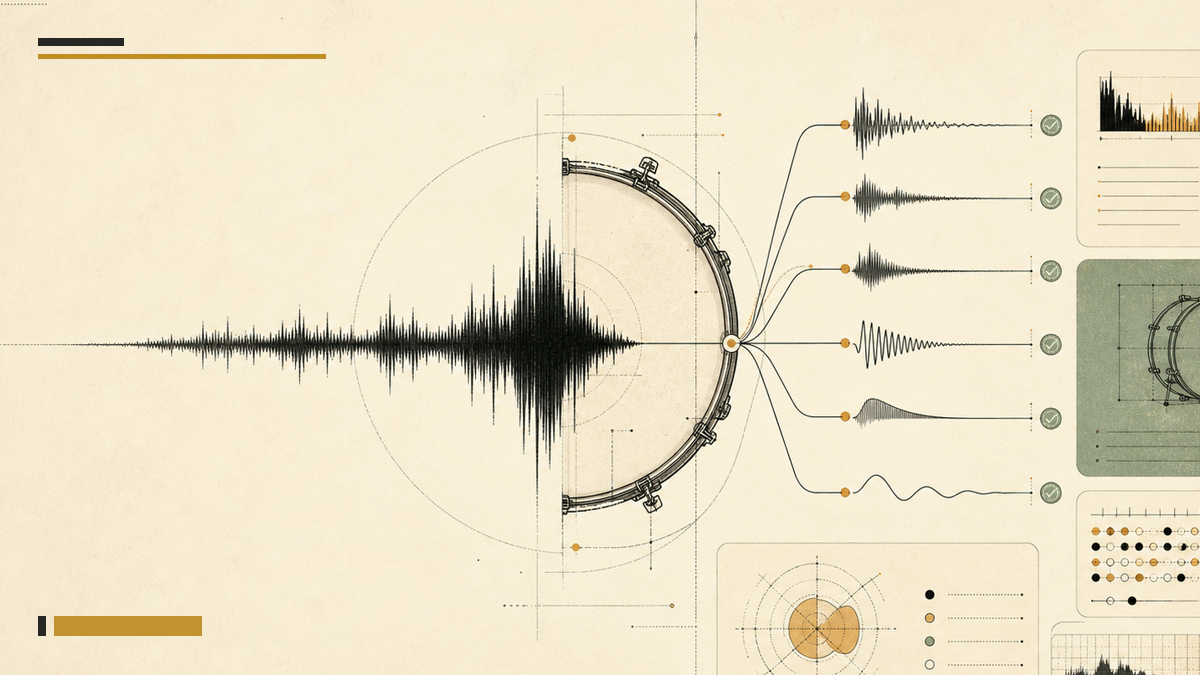
“Planet Rock” helped establish the TR-808’s bass drum as an intentionally electronic voice: deep, tunable and clearly part of a machine rhythm rather than an imitation of a live kit. The recording is best understood through a production team and a wider electro context, not a single-person invention story.
Historical and musical context
The kick belongs to a complete system
The record matters because the machine sound is presented as a positive aesthetic choice. The low electronic pulse belongs with sequenced rhythm, synthesiser timbre and an imagined future; it is not apologising for failing to sound acoustic. That shift opened a large creative space in which a kick could be pitched, lengthened and designed for speakers as its own electronic event.
Documented record
What the sources establish
- Sound On Sound documents the production context and credits around Afrika Bambaataa & the Soulsonic Force, producer Arthur Baker and musician John Robie.
- Roland and Smithsonian histories establish the TR-808’s early-1980s context and its later influence after an initially limited commercial life.
- Arthur Baker’s recollections are valuable first-person evidence; they remain recollections and should not be stretched into unsupported claims about every setting or signal path.
Original listening analysis
What to listen for in the kick relationship
Boundary: The observations below describe audible musical relationships. They do not claim access to private stems, exact settings or an undocumented session chain.
- The kick reads as a synthetic low-frequency event with a clean pitch-decaying body, not a close-miked acoustic drum.
- Space around the hits lets the electronic tail register while other machine voices create a precise grid.
- The sound’s importance comes from the whole production language: sequencing, timbre, arrangement, borrowing and futurist presentation.
Original listening model
Hear the kick role, not a copyrighted recording
These short synthesised examples are original Kickopedia demonstrations. They isolate the envelope and low-end relationship described in this dossier; they are not samples, stems or attempted replicas of ““Planet Rock””.
Choose an example. Keep your playback level moderate.
Translate the lesson
Production experiments to try
- Use a decisive pitch sweep into a stable low body rather than stacking an unrelated click on top.
- Leave enough space for the tail; shorten it when the bass or event density increases.
- Keep the machine quality audible instead of adding room treatment merely to imitate an acoustic kit.
- Name the team and the cultural context when telling the history.
Common mistakes
What this history does not prove
- Using “808” as a synonym for every long sub-bass note.
- Assuming a processed modern sample represents the original machine’s complete range.
- Reducing a collaborative recording to one person.
- Claiming exact knob positions from listening alone.
Listen for…
A four-part listening checklist
- A falling electronic pitch contour
- Tail length against pattern space
- Separation from other machine voices
- The kick as part of an explicitly electronic aesthetic
Sources and evidence
Inspect the material behind the claims
- Classic Tracks: Afrika Bambaataa & The Soulsonic Force: Planet RockSound On Sound
Production and credit context for the recording, including the electronic rhythm framework.
- Arthur Baker on Planet Rock, New Order and Unreleased SessionsReverb
First-person production recollection. Recollection is not treated as universal proof of every later claim.
- The History of the TR-808 Drum MachineSmithsonian Magazine
Historical context for the machine’s commercial reception and later influence.
- The TR-808 StoryRoland
Manufacturer history and instrument context. Manufacturer sources are identified as such.
- Kickopedia’s Landmark-Kick Evidence MethodKickopedia
The site-wide method for separating credits, equipment claims, recollection and listening analysis.
Related questions
Continue through the lineage
Electro and the TR-808
Place the recording inside the wider electro lineage.
Open guide →InstrumentHow the Roland TR-808 Kick Works
Understand the analogue bass-drum architecture.
Open guide →Comparison808 vs 909 Sound and Musical Roles
Compare recurring tendencies without turning machines into stereotypes.
Open guide →