
Landmark recording dossier · 1973
“The Love I Lost”: Earl Young and the Recorded Disco Pulse
A source-led study of Earl Young’s bass-drum pulse on Harold Melvin & the Blue Notes’ “The Love I Lost,” and why a continuous kick became a dance-floor language.
Documented performance · labelled listening analysis
Immediate answer
Why this recording matters to kick-drum history
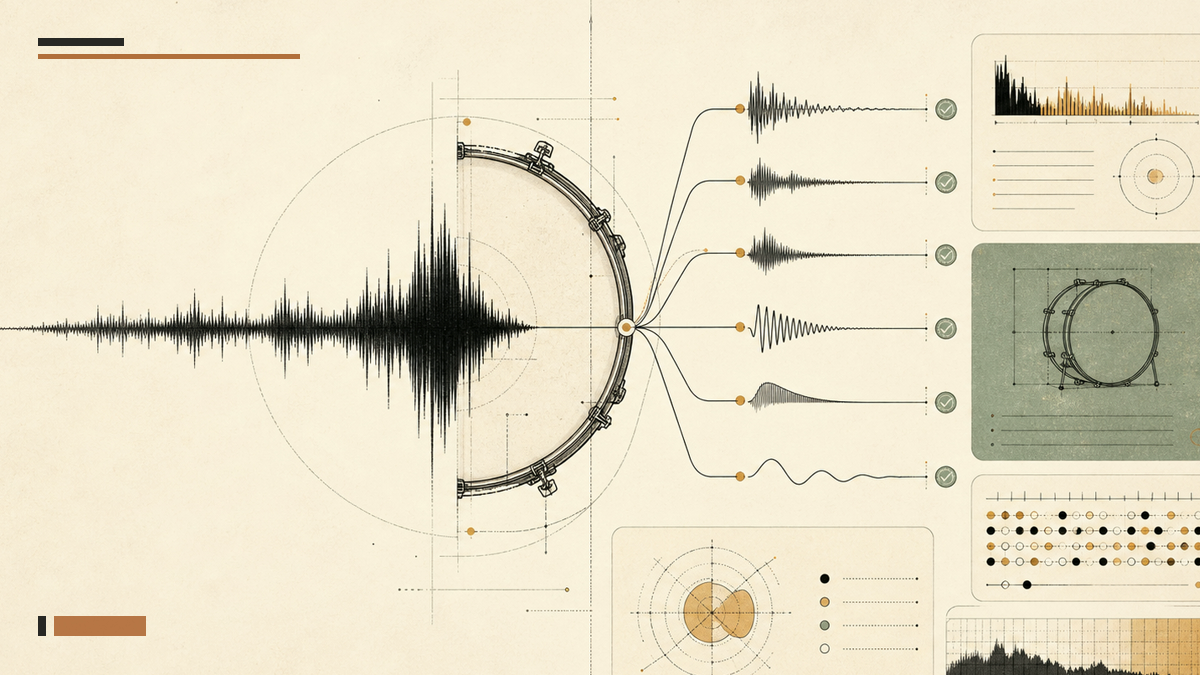
Earl Young’s driving quarter-note bass drum on Philadelphia International recordings is a major documented part of disco’s developing four-on-the-floor language. The important innovation was not simply “a kick on every beat”; it was a consistent physical pulse performed inside a live rhythm section.
Historical and musical context
The kick belongs to a complete system
The early-1970s recording sits at a useful transition: the repeated floor pulse is played by a drummer, yet it anticipates the continuous machine-grid logic that would later become common in club production. That makes the performance valuable for producers who want steadiness without erasing feel. The kick’s impact is inseparable from arrangement, musicianship and dancers’ ability to locate every beat.
Documented record
What the sources establish
- SPIN’s interview connects Young’s work with Philadelphia International, including “The Love I Lost”, to the developing disco beat.
- The contribution belongs to a wider system of musicians, arrangers, studios, DJs, dancers and venues. A credited drummer can be central without becoming a sole-inventor myth.
- The record precedes the later drum-machine standardisation of the club kick, so timing, dynamics and ensemble interaction remain part of the evidence.
Original listening analysis
What to listen for in the kick relationship
Boundary: The observations below describe audible musical relationships. They do not claim access to private stems, exact settings or an undocumented session chain.
- The bass drum keeps the quarter-note grid legible while bass guitar and other instruments provide melodic and syncopated motion.
- The kick feels insistent without behaving like a modern extended sub tail. Repetition and ensemble contrast create much of its authority.
- Small performance variations keep the pulse human while the recurring placement gives dancers an unambiguous floor.
Original listening model
Hear the kick role, not a copyrighted recording
These short synthesised examples are original Kickopedia demonstrations. They isolate the envelope and low-end relationship described in this dossier; they are not samples, stems or attempted replicas of ““The Love I Lost””.
Choose an example. Keep your playback level moderate.
Translate the lesson
Production experiments to try
- Begin with placement and consistency before adding more sub energy.
- Let the bass line move around a stable pulse rather than forcing both parts to carry the same rhythm.
- For a live-informed reconstruction, preserve modest velocity and timing variation; do not quantise the life out of the part.
- Judge the kick through the whole rhythm section. In isolation it may appear smaller than its musical role suggests.
Common mistakes
What this history does not prove
- Calling one person the sole inventor of disco.
- Trying to recreate the role with a long modern 808 tail.
- Mistaking loudness or sub extension for dance-floor clarity.
- Describing exact microphones or processing without a reliable session source.
Listen for…
A four-part listening checklist
- A continuous quarter-note floor
- Bass movement around a stable anchor
- Human consistency rather than mechanical identity
- The kick’s scale inside the full arrangement
Sources and evidence
Inspect the material behind the claims
- Earl Young and the Disco BeatSPIN interview
First-person and editorial context for Earl Young’s Philadelphia International recordings and four-on-the-floor contribution.
- Kickopedia’s Landmark-Kick Evidence MethodKickopedia
The site-wide method for separating credits, equipment claims, recollection and listening analysis.
Related questions
Continue through the lineage
How Disco Made Four-on-the-Floor a Dance-Floor Language
Follow the wider scene, technology and dance-floor lineage.
Open guide →Descendant lineageHouse Music’s Kick
Hear how the continuous floor moved into drum machines and house culture.
Open guide →PatternFour on the Floor
Experiment with the placement framework itself.
Open guide →